

The High Stakes Journey Of Multiple Births
The High Stakes Journey Of Multiple Births
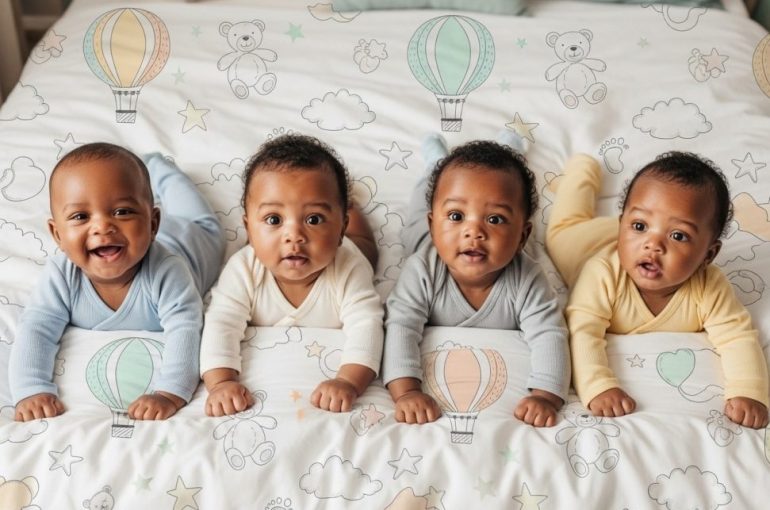
Parenthood in the modern age has been fundamentally reshaped by the miracles of science. The frontiers are being shifted almost on a daily basis. Yet, within the sterile precision of the embryology lab, there exists a phenomenon that is as much a statistical marvel as it is a medical challenge: this is known as the high-order multiple pregnancy. While the sight of twins,triplets or quadruplets in cribs or strollers often draws appreciation and admiration. Their existence is usually the culmination of a complex, high-stakes journey through Assisted Reproductive Technology – most especially Invitro-Fertilization (IVF).
Special world of multiples is a landscape where joy is doubled, tripled and quadrupled, but also where the shadow of risk, ethics, and physiological limits looms just as large. In the natural world, the odds of conceiving triplets are quite slim, around 1 in 8,000, while for quadruplets it is even slimmer, occurring spontaneously only once in every 700,000 births. Since the birth of Louise Brown, the first “test-tube baby,” in 1978, these odds have been dramatically rewritten.
High-order multiples in ART primarily arise from two distinct paths: In Vitro Fertilization and Ovulation Induction. In IVF, the traditional practice was to transfer multiple embryos into the uterus to maximize the chances of at least one “taking.” If three embryos were transferred and all three implanted, the result was an instant triplet pregnancy. In contrast, Ovulation induction, often using drugs like Clomiphene or injectable hormones, stimulates the ovaries to release multiple eggs in a single cycle. Unlike IVF, where the number of embryos is controlled in a dish, ovulation induction is less predictable; if a woman releases four eggs and all are fertilized, she may find herself expecting quadruplets.
The human uterus is evolutionarily designed for a singleton, one baby at a time. When that space is shared by three or four, the biological strain is immense. For the mother, the risks of preeclampsia, gestational diabetes, and placental abruption increase exponentially with each additional fetus.
The heart must work significantly harder to pump blood to multiple placentas, and the physical weight can lead to premature cervical dilation. For infants, the primary hurdle is prematurity. A typical singleton pregnancy lasts 40 weeks.Triplets are rarely carried past 32 to 34 weeks, and quadruplets often arrive as early as 28 to 30 weeks. These infants face a marathon in the Neonatal Intensive Care Unit, battling underdeveloped lungs, fragile brain vasculature, and digestive systems not yet ready for milk.
Perhaps the most harrowing chapter in the story of assisted multiples is the conversation regarding Multifetal Pregnancy Reduction. When a woman is found to be carrying four or five fetuses, medical providers often present a devastating choice: reduce the number of fetuses to two to increase the survival odds of the remaining babies, or carry all of them and risk losing the entire pregnancy to extreme prematurity.
For couples who have spent years and thousands of dollars trying to conceive, the idea of reducing a hard-won pregnancy is a psychological trauma of the highest order. It creates a paradox of grief and gratitude that many parents of multiples carry in silence for the rest of their lives.
In the 1990s and early 2000s, triplets were the face of IVF. Today, the medical community has shifted its stance. Modern reproductive medicine thrives as elective Single Embryo Transfer. Advances in cryopreservation and Preimplantation Genetic Testing have made IVF so efficient that transferring more than one embryo is increasingly seen as a failure of clinical judgment rather than a boost to success rates.
The goal is a healthy mother and a healthy baby. A triplet pregnancy is no longer viewed as a bonus success; in the eyes of many clinicians, it is considered a complication of treatment. For those who do bring home triplets or quadruplets, life enters a dimension that few can truly comprehend. The logistics are exact in their precision. A day in the life of parenting multiples involves dozens of diaper changes, simultaneous feeding schedules, and what is known as the “crying domino effect,” where one baby waking up triggers a sonic chain reaction. Yet, there is a unique psychology to these siblings. Triplets and quadruplets often develop a co-consciousness. They have never known a moment of life without a peer by their side. They develop their own languages, their own social hierarchies, and an unbreakable bond that begins in the crowded darkness of the womb.
The cost of raising triplets, and other high-order multiples is quite high. Beyond the immediate medical bills, families must navigate a specialized financial burden: the need for larger vehicles, larger homes, and the sheer cost of education and childcare. In many climes, societal support for such families may be lacking. But while the shock value of quadruplets might earn a family a guest spot on a morning talk show, the long-term reality is one of significant financial pressure.
In 2026 and beyond, the special world of triplets and quadruplets is likely to become even more celebrated. With the integration of Artificial Intelligence in embryology, labs can now predict with incredible accuracy which single embryo has the highest chance of implantation. However, as long as human biology remains unpredictable and the desire for children remains a driving force of the human spirit, multiples will continue to be born. They remain a testament to the boundaries of science and the resilience of the human body. Triplets and quadruplets born of assisted reproduction represent a unique intersection of human hope and scientific intervention.
They are the survivors of a high-stakes journey through the valley of infertility. While the medical world strives to make their occurrence a thing of the past in favour of safer, single births, those who live in this special world wouldn’t trade their chaotic, crowded, and miraculous lives for anything.